Marginal Pdf Calculator Tool
- Posted in:Admin
- 27/06/18
- 25
• • • In and, the marginal distribution of a of a collection of is the of the variables contained in the subset. It gives the probabilities of various values of the variables in the subset without reference to the values of the other variables.
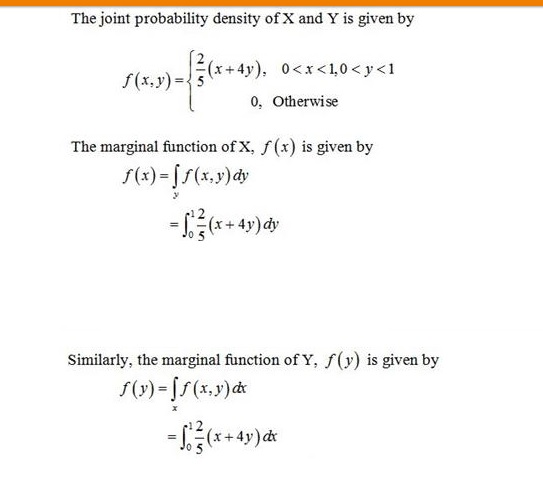
Joint and Marginal Distributions: Suppose the random variables X and Y have joint probability density function (pdf) fX,Y(x,y). The value of the cumulative distribution function FY(y) of Y at c is then. FY(c) = P( Y ≤ c). This calculator will compute the probability density function (PDF) for the normal distribution, given the mean, standard deviation, and the point at which to. The joint distribution of a pair of variables is a representation of the probability of each combination of results on those two variables. For example, if two variables are each the roll of a die, the distribution would show the probability of each combination of rolls. The marginal distribution is the distribution of.
This contrasts with a, which gives the probabilities contingent upon the values of the other variables. Marginal variables are those variables in the subset of variables being retained. These concepts are 'marginal' because they can be found by summing values in a table along rows or columns, and writing the sum in the margins of the table.
The distribution of the marginal variables (the marginal distribution) is obtained by marginalizing – that is, focusing on the sums in the margin – over the distribution of the variables being discarded, and the discarded variables are said to have been marginalized out. The context here is that the theoretical studies being undertaken, or the being done, involves a wider set of random variables but that attention is being limited to a reduced number of those variables. In many applications an analysis may start with a given collection of random variables, then first extend the set by defining new ones (such as the sum of the original random variables) and finally reduce the number by placing interest in the marginal distribution of a subset (such as the sum). Several different analyses may be done, each treating a different subset of variables as the marginal variables. H Red Yellow Green Marginal probability P(H) Not Hit 0.198 0.09 0.14 0.428 Hit 0.002 0.01 0.56 0.572 Total 0.2 0.1 0.7 1 The marginal probability P(H=Hit) is the sum along the H=Hit row of this joint distribution table, as this is the probability of being hit when the lights are red OR yellow OR green. License Feature Uc500-16u-upgrade there. Similarly, the marginal probability that P(H=Not Hit) is the sum of the H=Not Hit row.
In this example the probability of a pedestrian being hit if they don't pay attention to the condition of the traffic light is 0.572. Multivariate distributions [ ].
Math 480 Course Notes -- May 28, 1996 Bivariate distributions Recall that at the end of the last lecture we had started to discuss joint probability functions of two (or more) random variables. With two random variables X and Y, we define joint probability functions as follows: For discrete variables, we let p(i,j) be the probability that X=i and Y=j. This give a function p, called the joint probability function of X and Y that is defined on (some subset of) the set of pairs of integers and such that for all i and j and When we find it convenient to do so, we will set p(i,j)=0 for all i and j outside the domain we are considering. For continuous variables, we define the joint probability density function p(x,y) on (some subset of) the plane of pairs of real numbers. We interpret the function as follows: p(x,y)dxdy is (approximately) the probability that X is between x and x+dx and Y is between y and y+dy (with error that goes to zero faster than dx and dy as they both go to zero).